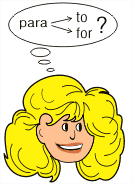
Preposições são palavras de significado pouco claro e muito variável. São mais partículas funcionais do que palavras de conteúdo semântico definido. A maioria das ocorrências de preposições não segue um padrão lógico ou regular. Além disso, entre o português e o inglês, as preposições não apresentam uma correlação muito estreita. Cobrem normalmente diferentes áreas de significado, sendo umas de uso mais amplo que outras.
É particularmente notória a dificuldade para nós, brasileiros, quando temos que decidir qual preposição usar em inglês, to ou for, quando em português a ideia seria expressa através da preposição para. Em geral, pode-se dizer que to está ligado à ideia de direção, movimento, correspondendo muitas vezes também à preposição a do português; enquanto que for está relacionado com a ideia de benefício, substituição, intenção ou destinação, correspondendo, às vezes, ao português por. Esta diferença de significado, entretanto, não é sempre clara. Mesmo assim, for e to raramente podem ser usados como sinônimos.
Frequentemente to e for introduzem o objeto indireto e é neste caso que as duas preposições normalmente correspondem ao português para. Objeto indireto em inglês é sempre um nome ou pronome que precede ou sucede o objeto direto nos verbos bitransitivos. Quando posicionado antes do objeto direto, não vem acompanhado de preposição. Quando posicionado após o objeto direto, virá invariavelmente acompanhado da preposição to ou for. Neste caso, a preposição certa dependerá do verbo, não havendo regra para isso. Observe os seguintes exemplos:
| I gave a present to him. | I gave him a present. |
| I'll show the figures to you. | I'll show you the figures. |
| He sold a car to me. | He sold me a car. |
| He sent a letter to Mary. | He sent Mary a letter. |
| Can you lend this book to me? | Can you lend me this book? |
| The boss told a joke to us. | The boss told us a joke. |
| Who teaches English to them? | Who teaches them English? |
| I paid $10 to the repairman. | I paid the repairman $10. |
| Will you pass the sugar to me? | Will you pass me the sugar? |
| Read a story to the children. | Read the children a story. |
| I wrote a letter to my friend. | I wrote my friend a letter. |
| Hand that book to me, please. | Hand me that book, please. |
| He offered a job to Mary. | He offered Mary a job. |
| He'll bring something to me. | He'll bring me something. |
| She sang a lullaby to the baby. | She sang the baby a lullaby. |
| I'll throw the ball to you. | I'll throw you the ball. |
| Let me buy a present for you. | Let me buy you a present. |
| I got some food for you. | I got you some food. |
| She made a sandwich for me. | She made me a sandwich. |
| Did she cook dinner for you? | Did she cook you dinner? |
| Can you do a favor for me? | Can you do me a favor? |
| He can find a job for you. | He can find you a job. |
| He left a message for you. | He left you a message. |
| Shall I pour more tea for you? | Shall I pour you more tea? |
| Reserve hotel rooms for us. | Reserve us hotel rooms. |
| Save the stamps for him. | Save him the stamps. |
Existem também verbos que só aceitam o objeto indireto quando acompanhado de preposição. Exemplos:
| The teacher said "Good morning" to the students. |
| He's going to introduce Mary to his family. |
| I already explained the project to the staff. |
| Mr. Cole described the new house to his wife. |
| I sometimes speak English to (with) my wife. |
| Bob reported the accident to the police. |
| I repeated your ideas to my parents. |
| He admitted his mistake to the boss. |
| I'll mention your plan to the director. |
| Dr. Bishop recommends this medicine to some patients. |
| Richard has announced his engagement to his friends. |
| It sounds good to me. |
| The salesgirl suggested a gift to Philip. |
| Can you carry the suitcases for me? |
| Could you open the door for me? |
| He asked the bank teller to cash a check for him. |
| Doctors like to prescribe medicine for the patients. |
| She is going to prepare the meal for the guests. |
| I asked her to sign the letter for me. |
| Can you hold this for me, please? |
| I changed the traveler's checks for you. |
| I asked the secretary to make an appointment for me. |
| He translated an article for me. |
| I recorded a tape for you. |
| I'll take the car to the mechanic for you. |
| The salesgirl suggested Philip a gift for his girlfriend. |
| Can you play the piano for me? |
Na verdade, quase qualquer verbo aceita o adjunto preposicional for. São portanto ilimitadas as possibilidades de FOR VERBS neste segundo grupo. Observe-se que mesmo os TO VERBS, além de aceitarem o objeto indireto precedido pela preposição to, também aceitam o adjunto preposicional for, porém com outro sentido. Ex:
No primeiro exemplo, Mary mora noutro lugar e eu lhe escrevi mandando notícias. No segundo exemplo, Mary escreveu uma carta para alguém, estava talvez muito ocupada para ir ao correio, e eu fui em lugar dela.
O verbo to go também frequentemente ocorre associado às preposições to e for. Observe-se os dois grupos abaixo:
| go to work |
| go to school |
| go to bed |
| go to church |
| go to town |
| go to court |
| go to pieces |
| go to hell |
| go to Porto Alegre |
| go to the bank |
| go to the office |
| go for a walk |
| go for a ride |
| go for a drive |
| go for a beer |
| go for it |
Uma das ocorrências mais elementares da preposição to é no uso do infinitivo em inglês. Isto normalmente ocorre na estrutura VERB + to + VERB. Exemplos:
| I have to go. |
| I like to drink beer. |
| I'm not able to work. |
| He decided to leave. |
| You promised to help us. |
| He's planning to study abroad. |
| I want to tell you something. |
| I hope to become fluent in English. |
| We expect to win the game. |
Mesmo quando não introduzem objetos indiretos, a ocorrência das preposições to e for continua dependendo do verbo que acompanham ou da expressão idiomática em que ocorrem. Em muitos casos for corresponde a por do português. Exemplos:
| Nice to meet you. |
| Up to date |
| To my surprise, ... |
| To the best of my knowledge, ... |
| According to ... |
| Apply to a university. |
| He reacted well to my comments. |
| I object to staying up late. |
| I'm accustomed to working hard. |
| I'm not used to working on Sundays. |
| It's very sensitive to cold weather. |
| To (for) me, it sounds good. |
| It's interesting to me. |
| She was invited to a party. |
| I'm looking forward to hearing from you. |
| It's a hundred miles from here to Porto Alegre. |
| They raised his salary to $1,000. |
| Don't jump to conclusions. |
| For sure! |
| For God's sake! |
| Good for you! |
| For example, ... |
| For this reason ... |
| For the first time ... |
| For (to) me, it sounds good. |
| Apply for a job. |
| Any letters for me? |
| I feel sorry for them. |
| He left for home. |
| I have a question for you. |
| He works for a tobacco company. |
| I sold my house for 40 thousand dollars. |
| He charged 50 dollars for the translation. |
| I lived abroad for 7 years. |
| He's very strong for an old man. |
| I'm looking for a job. |
| He received a grant for studying medicine. |
| I want eggs for breakfast. |
| I wrote a check for $100. |
